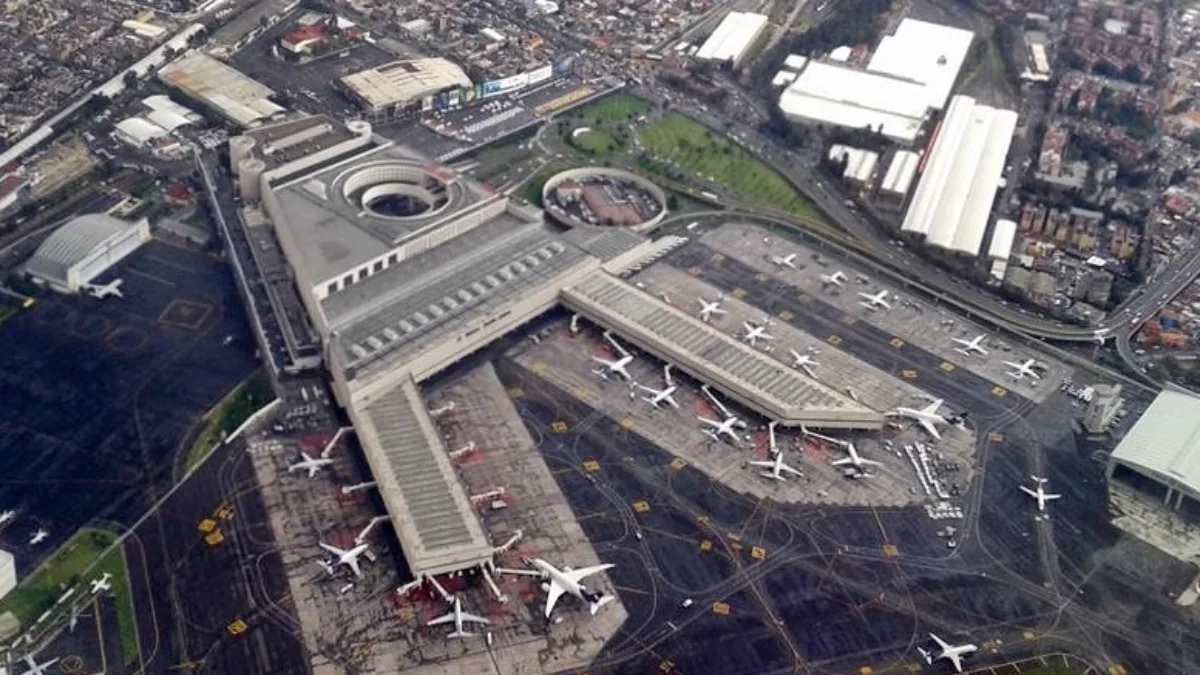
Mexico City’s Benito Juárez International Airport (AICM) reopened both runways after almost three hours of disruption caused by heavy rain and thunderstorm activity. The event affected thousands of passengers and highlighted how quickly a constrained urban airport can lose capacity when weather simultaneously affects runways, ground operations and traffic sequencing.
Nearly three hours of disruption
Runway 05L/23R returned to service at around 8:01 p.m. local time. The second runway, 05R/23L, reopened at around 8:38 p.m., allowing operations to recover progressively.
According to the post-event tally, 48 operations were affected: 43 inbound flights diverted to alternate airports and five departures were cancelled. Around 7,707 passengers were affected.
Why thunderstorms can stop an airport
Heavy rain does more than reduce visibility. It can reduce runway braking performance, slow ground movements, require inspections and lower arrival and departure rates. Lightning adds another safety constraint for ground crews, who may have to suspend some activities.
At a busy airport, a sudden capacity reduction quickly creates holding, diversions, crew-duty issues and passenger-recovery problems.
Benito Juárez has limited spare capacity
AICM is heavily constrained by its urban location and traffic volume. Its two runways are critical to throughput. Losing one or both therefore has an immediate impact on the schedule.
Unlike a hub with three or four independent runways, recovery capacity is limited. A closure lasting only a few hours can generate knock-on delays long after reopening.
Diversions complicate recovery
A diverted aircraft does not simply slot back into the original schedule. It may need fuel, a new departure slot, crew repositioning and passenger handling.
The 43 diverted arrivals were therefore a major source of disruption even after the airport reopened.
What passengers should expect
Residual delays can continue for several hours after this kind of event. Travellers should check directly with their airline because an official airport reopening does not mean every flight immediately returns to schedule.
AeroSillage analysis: the episode illustrates how a local weather event can become a wider network problem when airport infrastructure offers limited recovery margins.
Main sources
Aeropuerto Internacional de la Ciudad de México (AICM); Mexican airport authorities.
Related: Atlanta delays near two hours after severe storms, another example of how weather disruption can persist after operations resume.

Leave a Reply