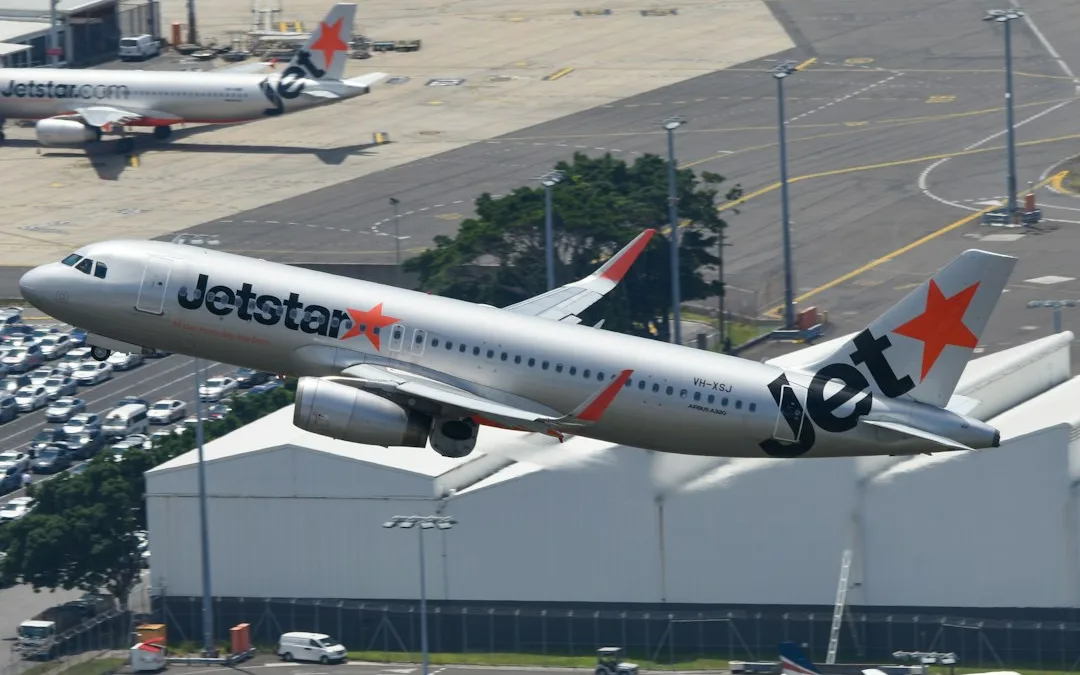
Jetstar airport workers have escalated protected industrial action across Australia during one of the country’s busiest travel weekends, with one-hour stoppages and bans on several non-essential passenger-service duties. The dispute affects staff at major airports including Sydney, Melbourne, Brisbane, Adelaide, Cairns, Gold Coast and Avalon, but Jetstar says its contingency plans mean it does not expect flight schedules to be disrupted.
The action, led by members of the Australian Services Union (ASU) and its branches, is the latest stage of a months-long enterprise bargaining dispute over pay and conditions. It began in escalated form on Friday, 2 October, as school-holiday traffic coincided with the NRL Grand Final weekend.
What Jetstar workers are doing
The industrial action is broader than a conventional walkout. Participating airport staff have been authorised to hold one-hour stoppages and to impose a series of work bans. These include restrictions on routine passenger announcements and calls, pre-positioning and some boarding procedures, as well as disruption and cancellation-management duties.
Safety and welfare-related work is excluded from the relevant bans. Union instructions also preserve assistance involving unaccompanied minors.
Workers have additionally been able to process some eligible passenger charges at zero dollars, including certain excess-baggage, seat-change and late fees. That tactic follows earlier action in September, when workers used measures designed to put financial pressure on the airline without necessarily grounding aircraft.
Which Australian airports are affected?
The action spans Jetstar airport operations at several of the carrier’s most important Australian locations. Reports and union material identify Sydney, Melbourne Tullamarine, Avalon, Brisbane, Gold Coast, Adelaide and Cairns, alongside action involving operational staff elsewhere in the network.
The timing is significant. Domestic travel demand is elevated around school holidays, while the NRL Grand Final creates an additional concentration of passenger traffic through Sydney and other east-coast airports.
Why are workers taking industrial action?
The dispute centres on a new enterprise agreement covering airport operations employees. The ASU argues that workers’ pay has failed to keep pace with living costs and says members are seeking a larger share of the airline’s improved financial performance, alongside better conditions, job security and protections for employees working in extreme weather.
ABC reported in August that the bargaining group covered 929 Jetstar airport operations workers, including customer-service employees involved in check-in, terminal baggage handling and aircraft marshalling. The Fair Work Commission subsequently recorded the result of the ASU–Jetstar protected-action ballot on 8 September, providing the legal pathway for protected industrial action during bargaining.
The 2.1% figure at the centre of the dispute
Union branches say Jetstar’s revised proposal would guarantee workers a 2.1% increase on current pay rates at commencement. The airline says its package is wider than that headline number: Jetstar has pointed to a further 3% increase from April 2027, back pay to April 2026, a new classification structure, improved penalties and allowances, and greater rostering flexibility.
The two sides therefore describe the offer very differently. The union characterises 2.1% as inadequate in the current cost-of-living environment; Jetstar describes its overall package as comprehensive and argues that it must balance employee outcomes with fleet investment, network growth, low fares and higher fuel costs.
Are Jetstar flights being cancelled?
There is no basis at this stage to describe the action as a wave of Jetstar flight cancellations. Jetstar says it has strong contingency plans and does not expect the industrial action to affect customers’ flights.
That distinction matters for passengers. Some airport processes may become less convenient when staff decline disruption-management or other non-essential duties, but industrial action does not automatically mean that a scheduled flight has been cancelled or delayed.
Travellers should continue to check Jetstar’s official flight status and communications before travelling, particularly while the action remains active or if the unions announce further escalation.
Why this dispute matters beyond one weekend
The immediate operational impact may remain limited, but the dispute has moved through several stages. Workers took action in September, the airline returned to bargaining, and unions then announced a fresh escalation after rejecting the revised wage outcome.
That makes the next bargaining round important. If no agreement is reached, the central aviation question is whether future protected action becomes more disruptive — through longer stoppages, wider work bans or measures affecting a larger share of airport operations. Conversely, a revised agreement could quickly reduce the operational risk.
A labour dispute inside the Qantas Group
Jetstar is the low-cost airline of the Qantas Group, and the union has repeatedly compared the position of its members with employees elsewhere in the group. For Jetstar, the challenge is to preserve the cost structure of its low-fare model while negotiating with airport staff who argue that the airline’s financial performance justifies stronger wage growth.
For passengers, the practical message is simpler: the dispute is real and the protected action is under way, but major flight disruption has not been established. AeroSillage will treat any future extension, suspension, settlement or material impact on the flight schedule as a separate development rather than assuming disruption in advance.
Sources
Australian Services Union / United Services Union, industrial-action notice of 29 September 2026; Fair Work Commission, protected-action ballot results; Jetstar statements reported by Australian Aviation; ABC News reporting on the enterprise bargaining dispute. Checked 4 October 2026.

Leave a Reply