
Airfares are doing something counter-intuitive in the French market. Jet fuel remains a major operating cost and carriers face pressure on several expense lines: yet average medium-haul fares sold in September 2026 fell sharply. Spain, Morocco, Tunisia, Egypt and especially Albania became cheaper, while long-haul fares moved in the opposite direction. AeroSillage analysed and re-ranked the values published in the Digitrips barometer, then cross-checked the wider market context against IATA, INSEE and France’s DGAC to understand why competition can still overpower a fuel shock.
AeroSillage Investigation of the Week: data checked through 8 October 2026.
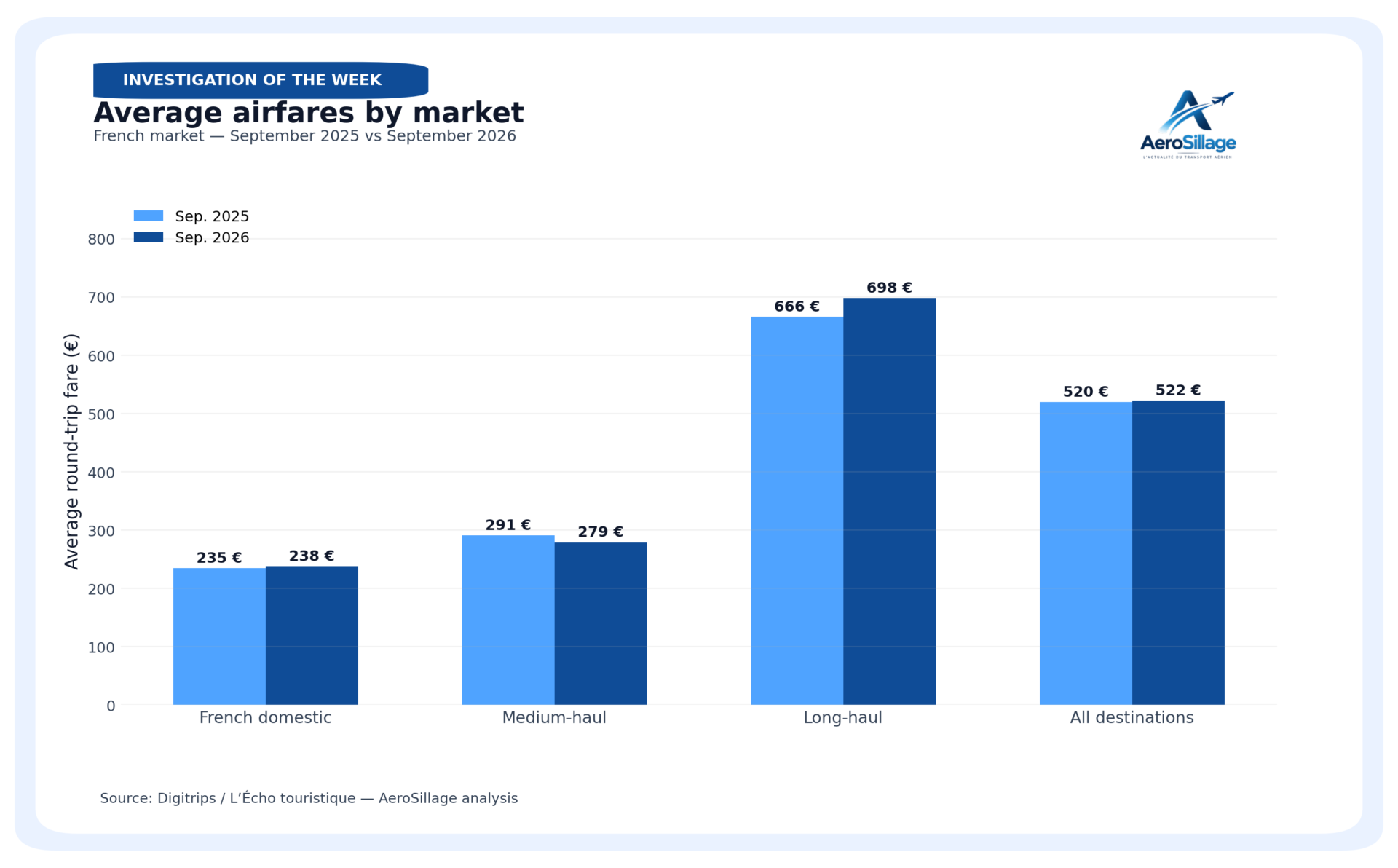
The split is striking: medium-haul down, long-haul up
The Digitrips barometer for L’Écho touristique is based on 98,029 round-trip economy-class tickets sold in France in September 2026, covering both nonstop and connecting itineraries. Its clearest signal is a 4.3% year-on-year fall in medium-haul fares.
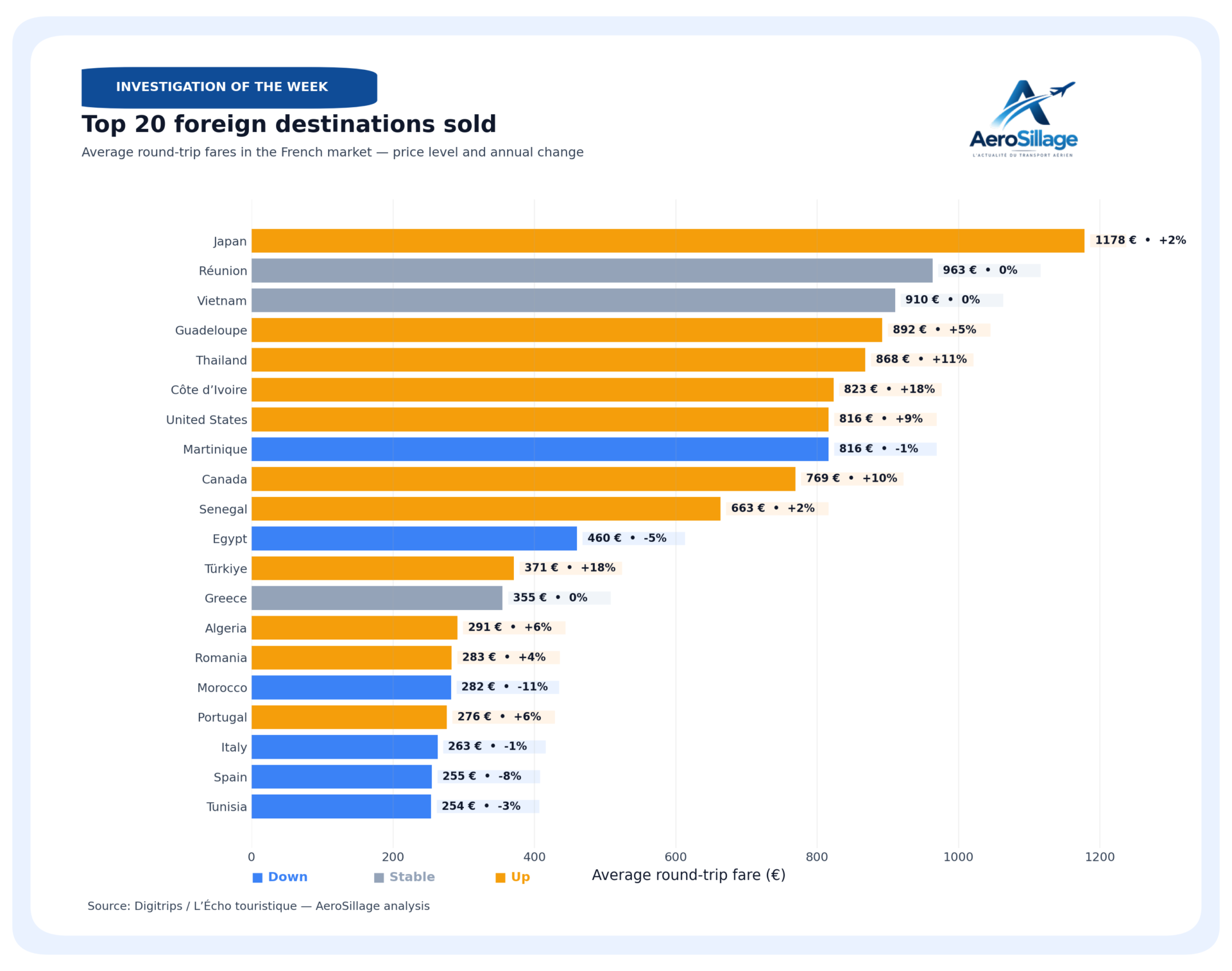
Top 20 destinations outside mainland France
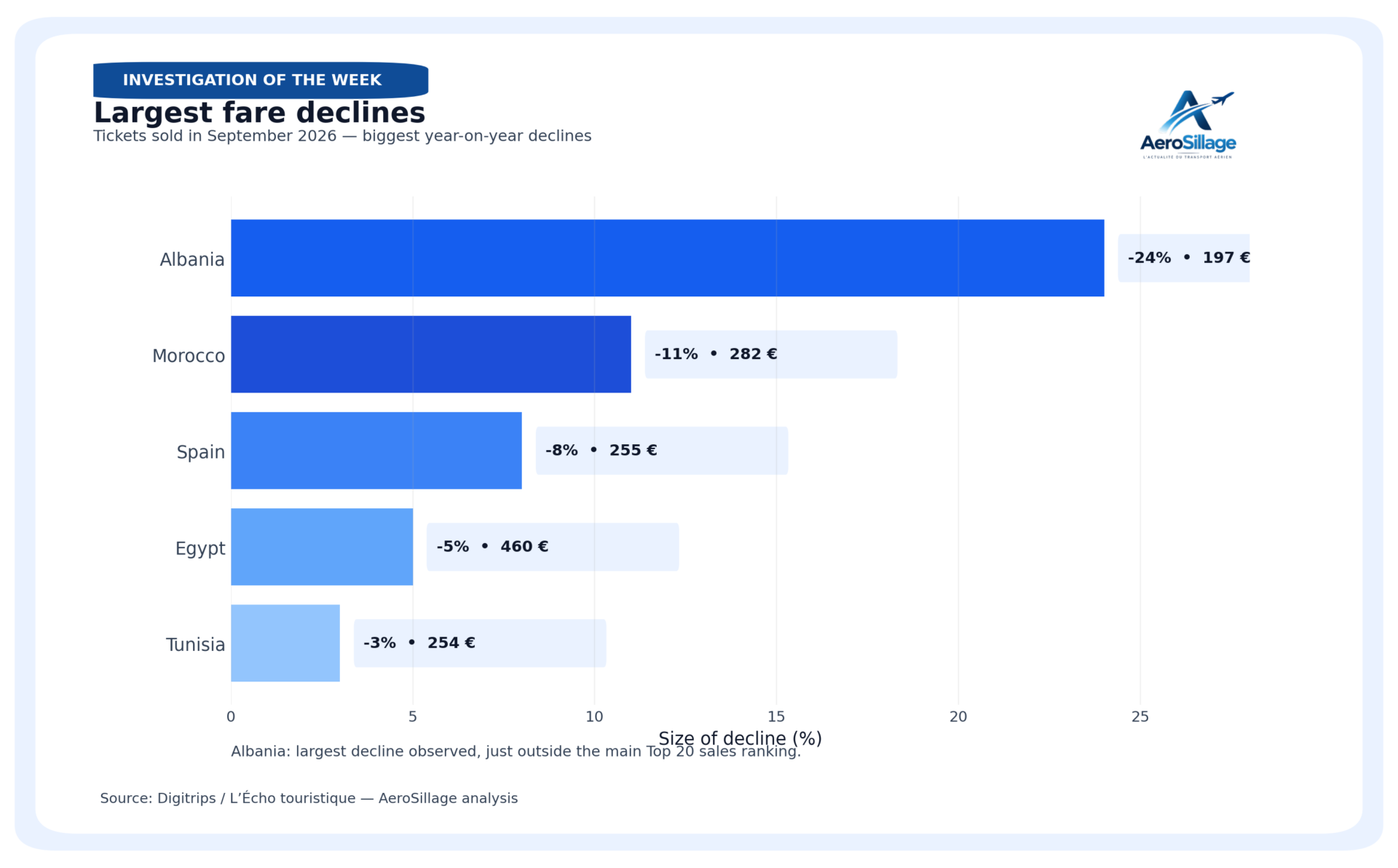
The biggest fare cuts
*Albania sits just outside the Top 20 at number 21, but gained 52 sales-ranking positions year on year.
The biggest increases tell the other half of the story
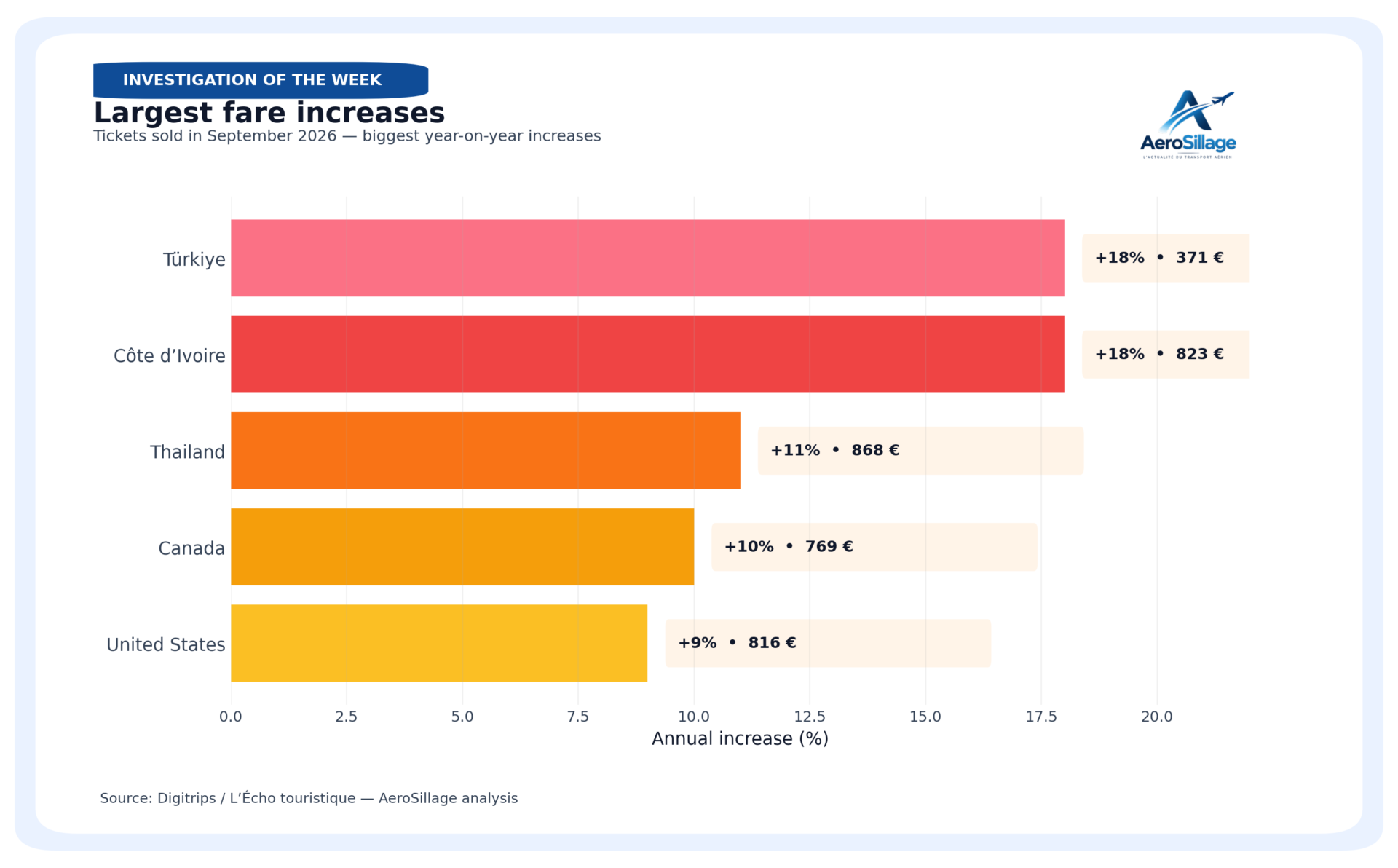
The contrast is important. September was not a broad-based fall in airfares. It was a redistribution of pricing pressure. Highly contested medium-haul markets absorbed more of the cost shock through yields, while several long-haul markets passed more of it through to travellers.
Fuel is expensive: so why cut fares?
IATA’s weekly monitor puts global jet fuel around $187 per barrel in early October. For 2026 as a whole, the industry fuel bill is expected to reach roughly $351 billion, about 31.4% of operating expenses. In Q2 alone, jet fuel averaged $158 per barrel, 27% higher than in Q1.
But airline pricing is not cost-plus pricing. A carrier does not simply add fuel, crew, maintenance and airport charges and then apply a fixed margin. Revenue management continually changes the fare according to remaining seats, booking pace, competitor pricing and expected demand.
If too much capacity is chasing the same passengers, fares can fall even while the cost of producing the seat rises.
This is where the distinction between cost and price matters. Fuel affects the economics of every flight, but the fare shown to a traveller is also a live response to booking pace, route capacity and rival offers. An airline may accept a weaker yield on one market because protecting load factor or network position is more valuable than immediately recovering every extra dollar of fuel cost.
Albania shows what capacity competition can do
Albania is the clearest example. The average return fare fell 24% to €197, while the destination jumped 52 places in the sales ranking. That coincides with a sharp expansion in supply. For summer 2026, Ryanair expanded its Tirana base to four aircraft, 44 routes and traffic growth of more than 50%, to around 4 million passengers a year. Capacity growth alone does not prove causation, but it is an important part of the competitive context behind unusually low fares.
The mechanism is straightforward: new seats must be filled. Price is the fastest lever. For travellers, that creates unusually attractive fares. For airlines, it can mean accepting lower yields in exchange for load factor, market share and network position.
Morocco matters more because it is already a mass market
Morocco is not an emerging niche. It is the second-most sold foreign destination in the dataset, yet its average fare fell 11% to €282. That makes it one of the most consequential moves in the ranking.
Competition is intense across a dense web of routes linking French cities with Casablanca, Marrakech, Agadir, Fez, Tangier and other Moroccan airports. Royal Air Maroc, Air France, Transavia, Ryanair, easyJet and other operators overlap in different combinations.
That density makes it harder for any one airline to pass the full fuel shock directly to consumers without risking share.
Why long-haul is different
Long-haul fares rose 4.8% on average. Long sectors burn far more fuel per rotation, are more exposed to geopolitical rerouting and often have fewer direct competitors on a given city pair.
The pattern is visible in the rankings: United States +9%, Canada +10%, Thailand +11%, Côte d’Ivoire +18%. The full barometer also flags Brazil at +22%.
Official French fare data tell a different: but compatible: story
France’s DGAC said airfares departing France were still 2.9% higher year on year in August 2026, with international fares up 4.4%. That appears to conflict with Digitrips’ September short-haul decline, but the datasets measure different things.
Digitrips tracks a specific commercial sample: economy return tickets sold in September through its market data. The DGAC IPTAP is a broader statistical fare index covering departures from France. Different month, sample and methodology mean both trends can coexist.
What this says about airline economics in 2026
IATA expects airline net profit to fall to about $23 billion in 2026, with a net margin of only 2%. Costs are rising faster than revenues. That makes widespread fare cuts difficult to sustain indefinitely.
If fuel remains expensive, airlines eventually have three broad options: raise fares, reduce capacity, or accept weaker margins. Which option wins depends on each market’s competitive intensity.
The lesson from September is therefore not that flying has become cheaper. It is that on heavily contested medium-haul markets, capacity and competition can temporarily overpower even a severe energy shock. For consumers, that creates opportunities. For airlines, it is a reminder that a full aircraft is not automatically a profitable aircraft.
What travellers should take from the data
The September snapshot is not a forecast and does not guarantee that the same routes will remain cheap. It does, however, identify where competitive pressure is currently strongest. Morocco, Spain, Tunisia and Albania stand out as markets where abundant capacity is working in the traveller’s favour. Canada, the United States, Thailand, Türkiye and Côte d’Ivoire show the opposite pattern.
For travellers, the practical conclusion is to compare routes and dates rather than assume that higher fuel automatically means every fare rises at the same pace. For airlines, the same data underline how unevenly a global cost shock can be transmitted across individual markets.
For further context, see AeroSillage’s reporting on the difference between advertised fares and the final ticket price, and its analysis of which destinations could become more expensive in 2027. These examine different questions and should not be confused with the September 2026 ticket-sales snapshot above.
Methodology and sources
AeroSillage based this analysis on the Digitrips barometer published by L’Écho touristique on 7 October 2026, covering 98,029 economy-class round-trip tickets sold in France during September. The market context was cross-checked against IATA’s Jet Fuel Price Monitor and 2026 economic publications, France’s DGAC passenger air-fare index, and INSEE’s September inflation estimate, as well as Ryanair’s official Tirana capacity announcement. Average fares are statistical observations, not bookable price guarantees.


Leave a Reply