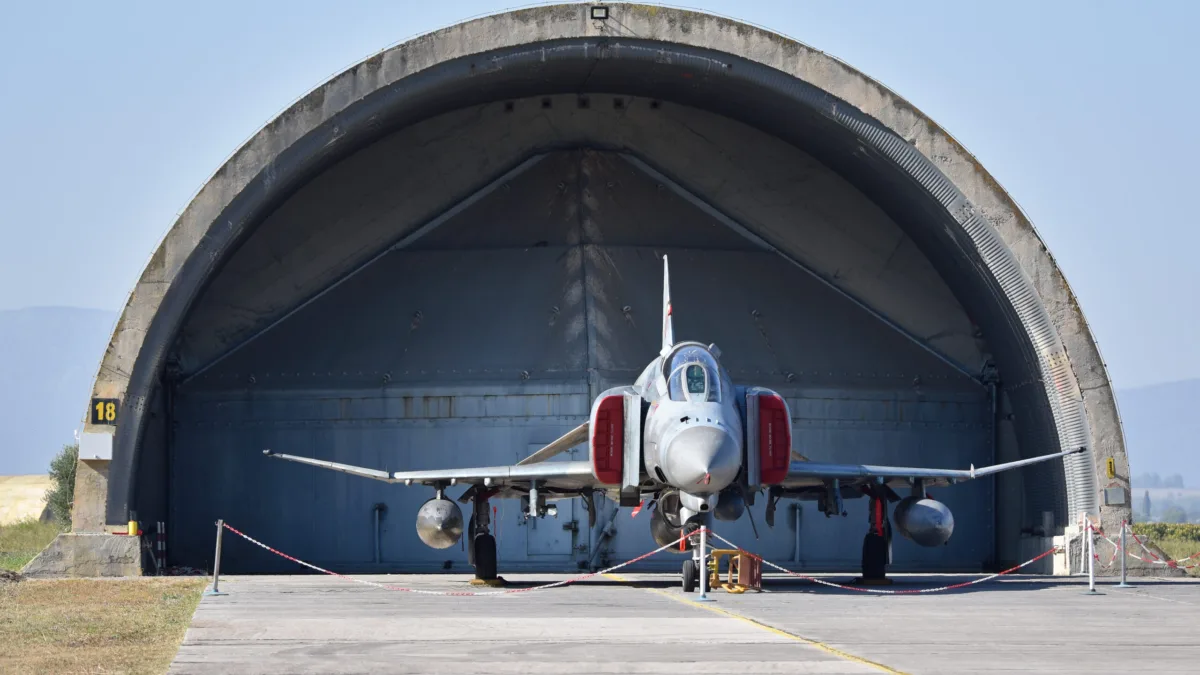
A Hellenic Air Force F-4E Phantom II crashed on Saturday, September 5, 2026 during a display at Athens Flying Week in Tanagra, killing both crew members. The accident happened at very low altitude in front of thousands of spectators and brought the flying programme to an immediate stop. Video helps reconstruct the final seconds, but it does not establish the cause.
The accident happened at 14:55 during the display
The Hellenic Air Force placed the crash at 14:55 on Saturday, September 5.
The aircraft belonged to the 338 “Ares” Squadron of the 117 Combat Wing at Andravida and was participating in the Athens Flying Week 2026 display programme at Tanagra.
According to the Greek Air Force, the aircraft came down roughly three nautical miles south-east of the 114 Combat Wing. Reuters reported that the crash occurred only minutes after take-off.
Footage shows the Phantom at low altitude in a turn before impact and a fireball. That sequence is valuable evidence, but it cannot by itself distinguish between a technical malfunction, flight-path problem, human factor or a combination of events.
Both aircrew were killed
The two crew members died in the accident. Greece’s Defence Ministry declared three days of mourning in the armed forces, from September 5 to 7.
The impact also started a vegetation fire, complicating the first emergency response and requiring significant firefighting resources.
No spectator was killed. Initial international reports said there were no injuries in the public area, while Greek broadcaster ERT later reported two people affected by debris. That detail required confirmation against the final official casualty record.
The rest of Athens Flying Week was cancelled
The event had been scheduled for September 5 and 6. After the crash, organisers cancelled the remainder of the flying programme and asked spectators to leave the base.
Because the accident happened during a public display, investigators will not only reconstruct the aircraft’s final trajectory; they can also review the display profile, safety lines and procedures surrounding the event.
The 338 Squadron is Greece’s last operational Phantom unit
The crash has particular significance because the aircraft came from the last Hellenic Air Force squadron still operating the F-4 Phantom II.
Greece has flown the F-4 since 1974. Part of the fleet underwent the Peace Icarus 2000 modernisation programme, which introduced the APG-65 radar, updated avionics and improved navigation and weapons capabilities.
The Greek Phantom of 2026 is therefore not electronically identical to the aircraft delivered in the 1970s, even though the basic airframe design dates back to a type whose first flight occurred in 1958.
Aircraft age is context: not an explanation
It is natural to ask whether the age of the Phantom mattered. That cannot be assumed.
Military aircraft kept in service for decades undergo structural inspections, maintenance programmes, component replacements and operating limitations based on remaining life.
An old aircraft is not automatically an unsafe aircraft. Age and structural condition will be part of the investigation, but there was no evidence at publication that age caused the crash.
The 2023 Greek Phantom crash will inevitably be examined: cautiously
On January 30, 2023, another F-4E from the same 338 Squadron crashed into the Ionian Sea south of Andravida during a low-level training mission. Both crew members were killed.
The comparison is relevant as background, but the two accidents should not be merged into one theory. The operational circumstances differ, and only the Tanagra investigation can determine whether any technical or procedural commonality exists.
What investigators will need to reconstruct
The Hellenic Air Force has assigned the accident to a competent investigative commission.
Key questions include the aircraft’s exact trajectory, altitude, speed and energy state in the final seconds.
Investigators can also examine air-traffic communications, display planning, the aircraft’s technical condition, engines, flight controls and maintenance history.
The many spectator videos can help establish attitude and flight path, but they need to be matched against technical evidence and wreckage findings.
Very low altitude leaves almost no recovery margin
Air displays routinely involve manoeuvres at lower altitude than normal operational flying.
That means any loss of energy, control problem or unexpected technical event leaves far less time and height for recovery.
The videos show the Phantom in a low-level manoeuvre immediately before impact. They do not establish why the trajectory was not recovered.
Calling the crash pilot error, engine failure or flight-control failure at this stage would go beyond the evidence.
Why did the ejection seats not save the crew?
The F-4E is equipped with ejection seats. Available footage does not clearly show a successful ejection before impact.
That does not prove that no ejection was attempted or that the system failed.
At very low altitude, seconds and aircraft attitude can determine whether an ejection is survivable. Investigators will need to establish whether the crew attempted to eject, whether the system functioned and whether the aircraft remained within a survivable ejection envelope.
Air-show safety will also be part of the wider review
The aircraft crashed away from the principal spectator area and no spectator was killed.
That separation is a central principle of air-show safety: display axes and manoeuvre zones are designed to reduce public exposure if an aircraft develops a problem.
The technical investigation will primarily focus on the aircraft and flight, but the event’s procedures and display profile may also be reviewed for lessons.
No official cause has been established
The most important fact remains the simplest: the cause was not known at publication.
Spectacular video can make an accident look immediately understandable. It is not. A descending flight path shows what happened; it does not explain why.
The final explanation may involve a technical problem, the circumstances of the manoeuvre, human factors or several events in sequence. Only the Greek investigation can determine that.
Main sources
Greek Ministry of Defence; Hellenic Air Force; Athens Flying Week; Reuters; Associated Press; official history of the 338 Squadron.
Leave a Reply