
F-16 crashes in Michigan; pilot ejects safely
A Texas Air National Guard F-16 crashed in Michigan during training. The pilot ejected safely as authorities evacuated the area around the wreckage.
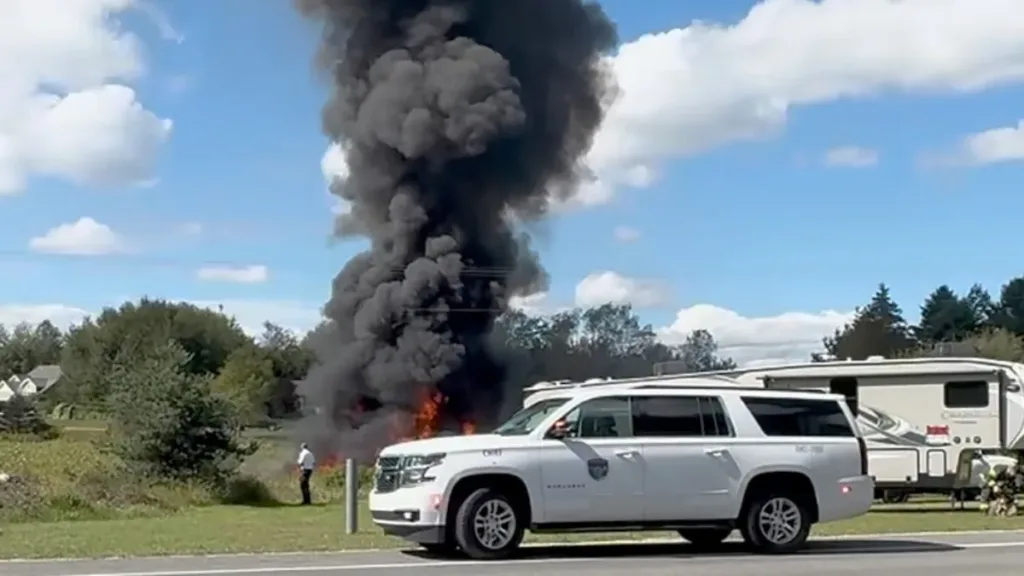
A Texas Air National Guard F-16 Fighting Falcon crashed in northern Michigan during a training mission on September 17. The pilot ejected before impact and was taken to hospital. Authorities evacuated homes and businesses within roughly one mile of the crash site because of hazardous materials associated with the wreckage.
The aircraft belonged to the 149th Fighter Wing and was operating from the Air National Guard Combat Readiness Training Center in Alpena when the still-unexplained incident occurred.
The pilot ejected before the aircraft came down in Grand Traverse County, near Grawn southwest of Traverse City. Authorities said the pilot was conscious, able to communicate with law enforcement and in stable condition. No other injuries were reported.
Evacuations around the crash site
The crash produced a large plume of black smoke. Michigan authorities established a safety perimeter and evacuated nearby homes and businesses because hazardous substances from the wreckage posed a potential risk.
Other Texas Air National Guard F-16s taking part in the Michigan exercise were temporarily grounded after the accident, according to a U.S. official cited by ABC News.
The pilot’s successful ejection prevented the worst outcome in the cockpit, but the emergency did not end when the aircraft hit the ground. A military crash outside a base creates risks beyond the aircraft and pilot. Fuel, fluids, possible munitions and aircraft materials can require a substantial public-safety response. The precautionary grounding of other aircraft also allows investigators to determine whether maintenance, environmental, procedural or technical factors could be shared.
The successful ejection and precautions around the wreckage do not explain why the aircraft was lost. Investigators will need to assess available flight, aircraft and training-mission evidence. The precautionary evacuation concerned hazards at the impact site and should not be confused with the cause of the crash.
The cause remains under investigation
Although air-traffic-control audio prompted speculation about a bird strike, but military authorities had not confirmed that hypothesis. It should therefore not be treated as the established cause of the accident.
Investigators will need to establish the sequence leading to the ejection, the aircraft’s technical condition, flight conditions and the precise nature of the hazard that prompted evacuations on the ground. Any conclusion on the cause remains premature until the competent authority releases its findings.
Sources: Texas Military Department, 17 September 2026; Associated Press; CBS Detroit.
Related on AeroSillage: Greece: what we know about the F-4E Phantom crash at Tanagra.
Read next
JOIN THE CONVERSATION
Let’s discuss this story.
A question, a clarification or a different perspective? Share it with us.