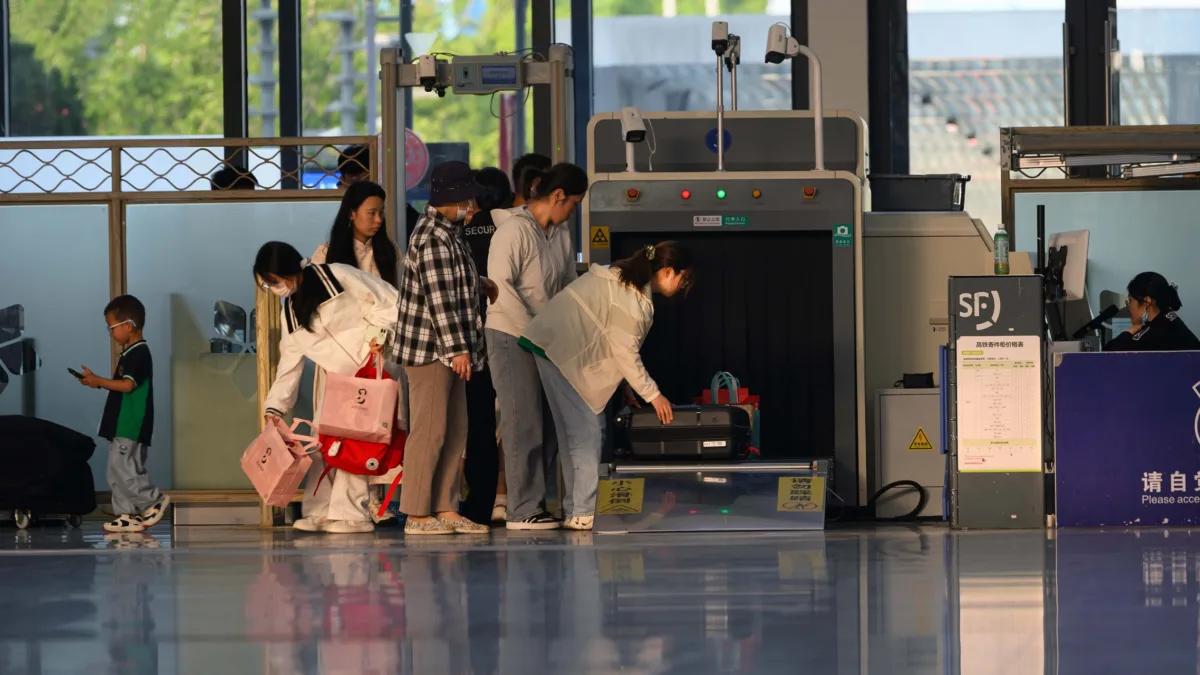
Airport security is easier to understand when travellers separate three different questions: what aviation security rules allow through screening, what dangerous-goods rules permit on board, and what the airline accepts as cabin baggage. Liquids, medicines, sharp objects, batteries and e-cigarettes cause much of the confusion because the same item can be legal at one stage and restricted at another.
Security and safety are not the same thing
In aviation, security is primarily about preventing weapons, explosives and other objects that could be used maliciously from entering the protected area or aircraft. Safety concerns accident prevention and operational hazards.
Lithium batteries illustrate the difference well: they are not mainly restricted because they could be used as weapons, but because damaged batteries can overheat and catch fire.
Liquids: the 100 ml rule still matters
At standard screening points in Europe, liquids, aerosols and gels are generally limited to containers of 100 ml or less, placed in one transparent resealable bag of about one litre per passenger.
The limit applies to the capacity of the container. A 200 ml bottle that is almost empty is still a 200 ml container and can be refused.
Some airports use newer scanners and may apply different procedures on particular lanes, but passengers should follow local instructions rather than assume every airport has abolished the 100 ml rule.
Jam, spreads and soft cheese can count as liquids
The rule does not only apply to drinks. Creams, lotions, gels, pastes, soups, sauces, jam, chocolate spread and soft cheeses can be treated as liquids or gels for screening purposes.
A sandwich or biscuit is normally not affected by the liquid rule, while a jar of jam or a large soft cheese may be.
Medicines and baby products can qualify for exceptions
Essential liquid medicines needed for the journey can exceed 100 ml when justified. Security staff may ask for a prescription, medical evidence or additional screening.
Baby milk and other liquids required for an infant can also be accepted in quantities needed for the journey. The same principle can apply to medically necessary special foods.
Tablets and capsules are not subject to the 100 ml liquid restriction.
Duty-free liquids: keep the security bag sealed
Liquids bought after screening or on board can normally be carried when placed in the sealed security bag supplied at purchase, with proof of purchase inside.
During a connection, do not open the bag unless security staff instruct you to. If it has to be opened for screening, tell staff that you are continuing your journey so it can be handled correctly.
Knives, scissors and cutting tools
European rules prohibit cutters, loose razor blades, axes, ice axes, swords and sabres. Knives with blades over 6 cm and scissors with blades over 6 cm measured from the pivot are also prohibited in cabin baggage.
A blade shorter than 6 cm is not automatically guaranteed acceptance. Security staff retain the final decision where an item could present a risk, and airports or airlines may apply stricter rules.
When an item is not essential in the cabin, placing it in checked baggage: where permitted: is generally the safer option.
Tools and blunt instruments
Crowbars, drills, saws, blowtorches, nail guns and certain tools with long blades or shafts are generally prohibited in the cabin. Baseball bats, clubs and some martial-arts equipment are also restricted.
Weapons, replicas and defensive sprays
Firearms are prohibited in cabin baggage, as are realistic replicas and imitations. Air guns, bows, crossbows, harpoons and similar equipment are also restricted.
Stun devices, Tasers, electric batons, pepper spray and tear gas are prohibited in the cabin. Sporting and hunting firearms in checked baggage follow a separate declaration, packaging and approval regime.
Explosives, fireworks and hazardous substances
Explosives, fireworks, incendiary devices and many flammable, toxic or corrosive substances are prohibited from passenger baggage or subject to strict dangerous-goods rules.
Not every aerosol is treated identically, so the exact product and airline conditions should be checked before travel.
Power banks and spare lithium batteries: cabin only
Power banks and spare lithium batteries must not be placed in checked baggage. They should remain in the cabin, protected against short circuit.
100 Wh is a common threshold above which airline approval or additional conditions may apply. Damaged, defective or safety-recalled batteries should not be carried.
E-cigarettes: cabin only, no charging on board
E-cigarettes and spare batteries should remain in cabin baggage and be protected against accidental activation. They must not be recharged during the flight.
If your cabin bag is gate-checked
If overhead bins are full and the airline moves your cabin bag into the hold, remove items prohibited in checked baggage before handing it over: especially power banks, spare lithium batteries and e-cigarettes.
Security rules are not airline baggage rules
Security staff do not decide the size or weight included in your fare. Those limits are set by the airline.
A bag can therefore pass screening perfectly and still be charged or refused at the gate because it is too large or heavy for the ticket purchased.
How to prepare for screening
Keep liquids easy to remove where required. Be ready to take out laptops and larger electronics if instructed. Coats and jackets may also need to be removed.
Procedures differ by airport and scanner type, so local instructions always take priority.
Ten easy mistakes to avoid
- Taking a 200 ml container that contains only 50 ml.
- Forgetting that jam, spreads and soft cheese may count as liquids.
- Opening a sealed duty-free bag during a connection.
- Putting a power bank in checked baggage.
- Leaving a power bank inside a cabin bag that is gate-checked.
- Assuming a short knife is automatically accepted.
- Carrying pepper spray or a stun device in the cabin.
- Confusing airline bag-size rules with airport security rules.
- Travelling with a damaged lithium battery.
- Waiting until the airport to check an unusual item.
The safest approach: check before you leave
For departures from France, the DGAC AIRBAG tool is a useful reference for regulated and prohibited articles. Travellers should also check the airline whenever prior approval, quantity limits or special packaging may apply.
Quick AeroSillage checklist
Liquids: normally 100 ml maximum per container in a resealable transparent bag.
Medicines and baby products: exceptions can apply when necessary for the journey.
Sharp objects and tools: many are prohibited in the cabin.
Power banks: cabin, not checked baggage.
E-cigarettes: cabin only, no charging on board.
When unsure: check DGAC AIRBAG and the airline before travel.
Official sources
DGAC / French Transport Ministry; European Commission aviation-security information; EASA dangerous-goods guidance.
Leave a Reply