
Norse Atlantic drops Gatwick–New York flights for winter
Norse Atlantic has suspended London Gatwick–New York JFK flights for winter 2026–27, alongside its Rome–New York service. The decision comes as the airline cuts capacity and shifts its focus towards Asia.
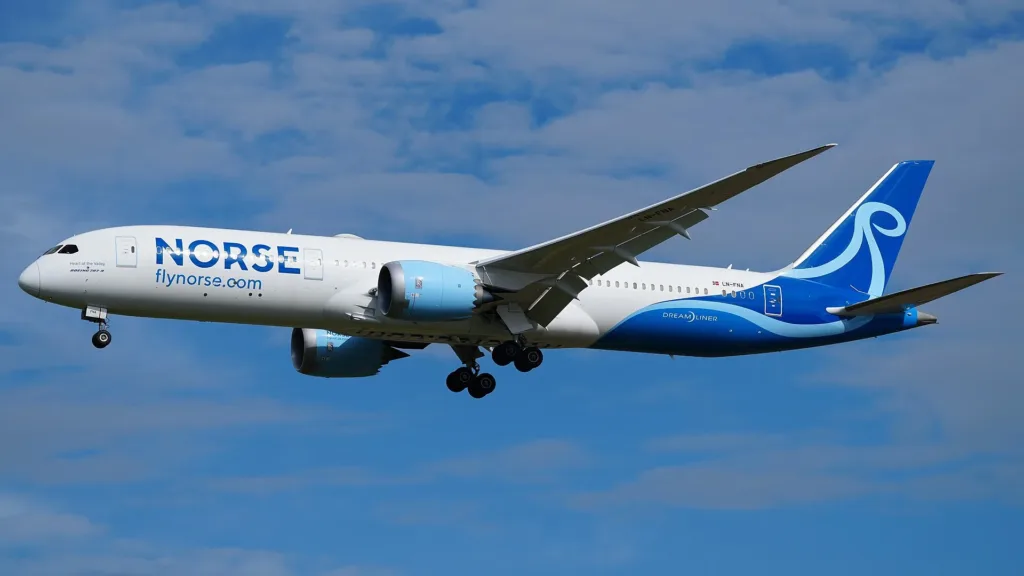
Norse Atlantic Airways has suspended its London Gatwick–New York JFK flights from Sunday 25 October 2026, removing a low-cost transatlantic option for the winter as the airline concentrates more of its long-haul flying on Asia. The Gatwick route, operated by Norse Atlantic UK, and the carrier’s Rome Fiumicino–JFK service are absent from timetables until 27 March 2027.
Both routes had been scheduled to operate three times a week with Boeing 787-9 Dreamliners. AeroRoutes reported the changes on 22 September, after Norse amended its winter flight programme. This is a seasonal suspension in the published schedule, not evidence that the airline has permanently abandoned New York or promised to restart the services next March.
For passengers in Britain, the withdrawal matters beyond one airport pairing. Norse entered the market selling comparatively inexpensive direct long-haul journeys, with Gatwick–JFK one of its original routes in 2022. Its winter schedule now has just one planned service to the United States, Gatwick–Orlando, according to an OAG timetable analysis published by Aviation Week. It leaves fewer Norse options for anyone seeking a direct flight to the US east coast.
Norse Atlantic removes more than 83,000 planned New York seats
The scale of the change is clearest in capacity figures. OAG data examined by Aviation Week put the combined winter capacity previously planned for Gatwick–JFK and Rome–JFK at about 83,200 two-way seats, roughly 41,600 for each route. That measures airline seats taken out of a schedule. It does not mean 83,200 passengers have had confirmed bookings cancelled.
The same comparison showed Norse’s overall planned winter network shrinking from about 552,000 to 446,500 two-way seats between timetable filings. The two New York routes accounted for most of that revision. Norse has not published a route-specific figure for affected ticket holders, and the schedule data does not reveal how many customers had already booked flights on the withdrawn dates.
Thailand takes priority as higher fuel costs squeeze Norse
The airline’s remaining network looks markedly different from its early transatlantic ambitions. OAG’s winter analysis puts flights between Europe and Thailand, including Bangkok and Phuket services from Gatwick and Manchester, at approximately 313,000 seats. That represents about 70% of the planned network. It is a shift in where Norse has chosen to deploy aircraft, rather than proof that demand for London–New York travel has disappeared.
Norse itself has linked its reduced flying to high fuel prices. In a 7 October company statement, chief executive Eivind Roald said it was maintaining lower capacity because of prolonged fuel-cost pressure and had adjusted the winter programme to put more emphasis on the Far East. The company reported a 96.9% load factor in September, with 109,202 passengers carried across its scheduled and charter operations, down 32% on a year earlier.
Revenue per available seat kilometre in Norse’s own network rose 35% year on year to 5.8 US cents. These are company-wide traffic and unit-revenue measures: they cannot establish whether the Gatwick–New York route was profitable or what specific commercial consideration led to its suspension. An aircraft can fly nearly full while still facing sharply higher operating costs.
The company’s second-quarter results, issued on 20 August, showed revenue of $132 million and negative earnings before interest, tax, depreciation, amortisation and rent (EBITDAR) of $8.4 million. Norse also described a cost-reduction programme targeting $50 million of annual savings from 2027. Those figures help explain the pressure on the airline’s strategy without providing a cause for any individual flight cancellation.
IndiGo aircraft return while Norse prepares flights for PIA
The reshuffle comes as Norse changes how it uses its fleet of Dreamliners. In a 31 July operational update, the airline said its arrangement supplying aircraft to India’s IndiGo would end on 1 November. At that point it was considering using returning aircraft for more flying to destinations including New York and Orlando, as well as for new contracts with other airlines. Its September schedule filing subsequently removed New York from the winter programme.
On 9 October, Norse announced a separate agreement to provide two Boeing 787-9s to Pakistan International Airlines for services between Pakistan and the UK. Norse said the operation was expected to begin in early November. Under the ACMI arrangement, it supplies the aircraft, crew, maintenance and insurance while PIA uses the capacity for its own network.
This alternative source of flying illustrates the company’s move towards a more flexible model in which it operates both its own passenger services and aircraft for airline partners. Norse has also begun a strategic review which it has said could lead to a partnership, merger or sale. None of those possibilities has been announced as an agreed transaction.
What Gatwick passengers can do if a Norse flight is cancelled
Customers who booked Gatwick–JFK travel during the withdrawn period should check their original itinerary and any communication from Norse or the booking agent. A route disappearing from a future timetable is not, by itself, confirmation that every booking on that route has already been cancelled or refunded.
For a cancelled departure from Gatwick, the UK Civil Aviation Authority explains that passengers covered by UK law can choose a refund or rerouting, either at the earliest opportunity or at a later suitable date subject to available seats. Where appropriate, rerouting can involve another airline. A passenger who still needs to reach New York should examine that choice before accepting a refund, because the original fare may no longer buy an equivalent ticket.
Fixed-sum compensation is a separate question. According to the CAA, eligibility depends on notice given to passengers, the replacement itinerary and the circumstances of the cancellation. Norse’s published winter schedule does not establish whether compensation is payable in any individual case. Passengers on return flights should also check the operating airline, because the scope of UK passenger-rights rules differs for journeys into Britain.
The schedule currently records 27 March 2027 as the end of the suspension period. Norse has not established a firm return date for Gatwick–JFK in the evidence reviewed. For the coming winter, its US operation is reduced to Orlando while aircraft and flying hours are directed increasingly towards Thailand and airline partners.
Read next
JOIN THE CONVERSATION
Let’s discuss this story.
A question, a clarification or a different perspective? Share it with us.