
Douglas DC-8 veers off Kinshasa runway after return to N’Djili
A Trans Air Cargo Service DC-8, registration 9S-AJO, left Runway 24 at Kinshasa-N'Djili after returning from a flight towards Kisangani on 8 September 2026.
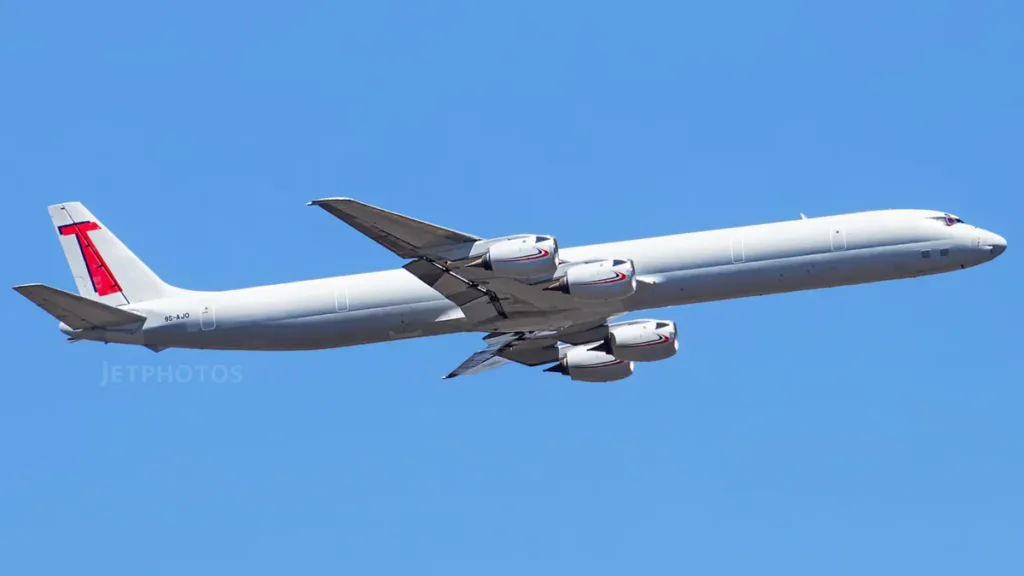
A Trans Air Cargo Service Douglas DC-8 freighter ran off Runway 24 at Kinshasa-N’Djili airport on 8 September 2026 after returning from a flight intended for Kisangani, Congolese accident investigators have reported. The aircraft, registered 9S-AJO, came to rest on soft ground with its nose landing gear collapsed.
The unusual four-engined cargo aircraft had departed Kinshasa before turning back. Initial accounts conflicted over whether the excursion occurred during departure or landing. Information subsequently attributed to the Democratic Republic of Congo’s Bureau permanent d’enquêtes d’accidents et incidents d’aviation, or BPEA, clarified that the aircraft was returning to N’Djili.
BPEA describes the runway excursion
According to the BPEA account reported by The Aviation Herald on 15 September, the DC-8 landed on Runway 24, touching down roughly 200 metres beyond the threshold. It continued along the runway before veering left near its end, coming to rest about 100 metres beyond the paved shoulder. Investigators attended the site and began examining the circumstances.
Early reporting mentioned a possible hydraulic problem. That remains preliminary information, not an established cause. A runway excursion can result from several interacting factors, and the condition of the landing gear after the event does not explain what initiated the deviation.
An increasingly rare cargo aircraft
Registration 9S-AJO identifies a Douglas DC-8-73CF, a version of the long-serving four-engined type fitted with modernised engines for cargo use. Very few DC-8s remain active in commercial operations. Its rarity makes the loss significant to the remaining fleet, but aircraft age alone says nothing conclusive about the accident sequence.
The BPEA investigation will need to consider the approach, landing rollout, aircraft systems and any evidence from the crew and airfield. No final cause was announced in the material reviewed for this update.
Sources: BPEA preliminary account as reported by The Aviation Herald, 15 September 2026; AeroInside accident chronology. Related reading: AeroSillage’s analysis of the Airbus A350F and Boeing 777-8F freighter programmes.
Read next

JOIN THE CONVERSATION
Let’s discuss this story.
A question, a clarification or a different perspective? Share it with us.