False hijack alert: German Eurofighters escort Corendon Boeing 737 to Nuremberg
German Eurofighters escorted a Corendon Boeing 737 after a false squawk 7500 alert. The flight landed safely and no hijacking occurred.
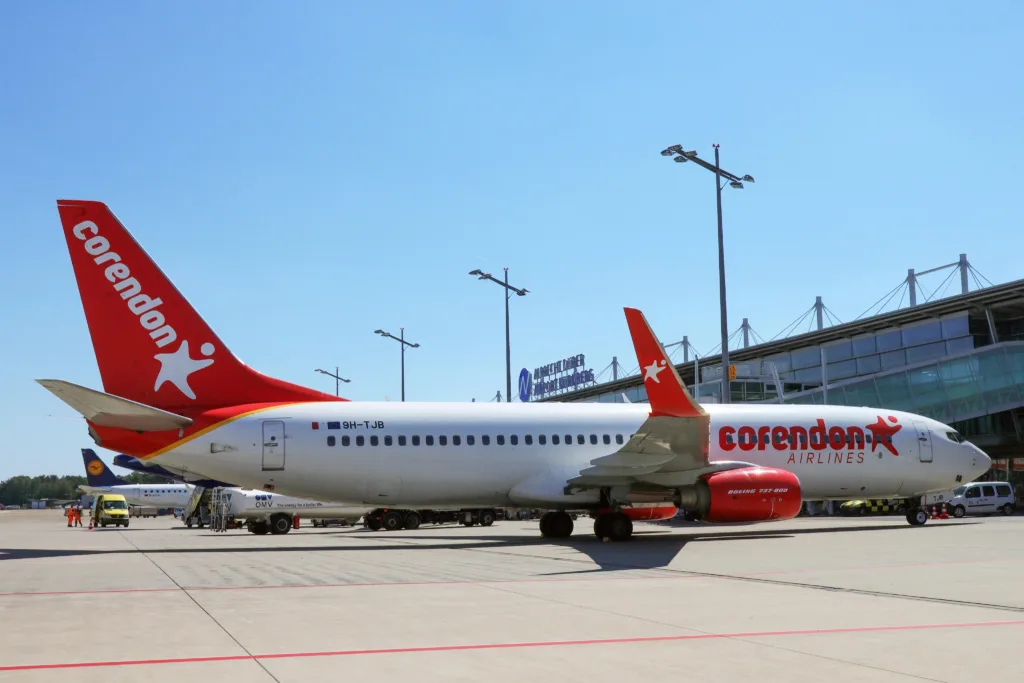
A routine flight from Corfu to Nuremberg triggered a military response on 13 October 2026 after a Corendon Airlines Boeing 737-800 transmitted squawk 7500, the internationally recognised transponder code associated with unlawful interference. Two German Eurofighters escorted the aircraft, which landed safely. The airline subsequently said there had been no hijacking.
What happened during the flight?
Reuters and the Associated Press reported that a communications-related problem emerged while the aircraft was still over Croatian airspace. A signal indicating a possible hijacking prompted German authorities to deploy fighters from Neuburg air base. Nuremberg Airport temporarily halted flight operations while the alert was investigated.
The Associated Press reported that 178 passengers were on board. The airport’s precautionary response affected other services through delays and diversions. The flight itself ultimately reached its planned destination safely.
What does squawk 7500 mean?
Air traffic controllers use transponder codes to identify situations that require immediate attention. 7500 signals suspected unlawful interference; 7600 indicates radio communications failure; and 7700 is the general emergency code. The codes convey critical information even when ordinary voice communications are compromised.
Because a 7500 transmission may indicate a threat to those on board, authorities must investigate promptly. Military interception is a way to identify an aircraft and assess its behaviour; it does not mean officials have established that a hijacking is taking place.
The response extended beyond the flight deck. According to the Associated Press, six other flights were delayed and two diverted as airport authorities dealt with the alert. Police and emergency services were mobilised on the ground. Those operational consequences matter even though the airline later said the aircraft had never been hijacked.
The incident also illustrates a fundamental distinction: an emergency transponder code is a warning to be investigated, not proof that the suspected event has occurred. When radio contact is disrupted, authorities may have to act on incomplete information. Fighter interception provides an additional means of assessing the aircraft while controllers and emergency services prepare for the possibility of a genuine threat.
The aircraft landed at Nuremberg at about 12:16 local time, according to German reporting, while the airport reportedly reopened around 13:30. This interval reflects the work involved in confirming safety and reopening an airport following an alert. Six flights were delayed and two diverted; these were not eight cancellations. The response followed a precautionary chain: controllers sought clarification, fighter aircraft were scrambled to assess the situation, and ground services prepared for a possible emergency.
The incident should not be linked to recent drone alerts or sabotage allegations without evidence. No such connection has been established. The key question is how a communication malfunction led to the 7500 warning, and whether procedures prevented a technical anomaly from developing into a greater safety risk. The absence of a genuine hijacking does not mean the response was unnecessary: treating a warning as serious until it can be ruled out is fundamental to aviation security.
Why an erroneous signal still matters
Corendon attributed the incident to a communications malfunction and stressed that no genuine threat existed. Even so, the episode demonstrates why the aviation security system is designed to respond to the signal first and clarify its origin afterwards. The disruption to airport operations highlights the wider consequences of an alert that ultimately proves false.
A military escort is a precautionary response to a signal that authorities must initially treat as potentially serious. It is not evidence that a hijacking was taking place. The warning received by controllers, the decision to scramble fighters and the findings after landing should be described as distinct stages.
The case also illustrates the coordination required between civilian air traffic services and military responders. An unusual transponder signal can trigger a substantial response within minutes, even when the aircraft ultimately lands without incident. Any explanation for how the code was transmitted must remain tied to confirmed findings.
The aircraft landed at Nuremberg at about 12:16 local time, according to German reporting, while the airport reportedly reopened around 13:30. That gap reflects the work required after an alert: confirming the situation on board, completing safety checks and restoring normal airport traffic. Six flights were delayed and two diverted, according to the Associated Press. These consequences should not be conflated with cancellations.
The response followed an escalation logic rather than a confirmed hijacking scenario. Air traffic services receive an abnormal signal and seek clarification; the military can then provide an external visual assessment while the airport prepares for a potentially serious incident. When cockpit radio communication is unavailable, a transponder code carries unusually high weight, even though the signal may later be shown to be erroneous. This is why a rapid response and a later finding of no threat are not contradictory.
Germany and other European countries have also faced reports of drones near aviation infrastructure, but there is no established connection between this Corendon incident and any drone intrusion or sabotage attempt. Introducing such a link without evidence would misrepresent what authorities and the airline have actually said. The relevant unanswered question is the precise technical sequence that produced the transponder warning and communication anomaly, not a hypothetical hijacking that did not take place.
Sources: Reuters and Associated Press, 13 October 2026.