
The aviation journal
Press review
Essential aviation news, in perspective

Ibiza's cancellation toll rises, Austrian diverts, Riyadh reopens without full service, Italy recovers and France's strike remains suspended.
Air transport enters Monday with sharply different recovery timelines. Ibiza’s storm cancellations rose well beyond the first count, while Riyadh’s airport reopening has not brought every airline back. A bomb threat diverted an Austrian Airlines flight, Italy’s air traffic system is back to full capacity, and France’s planned national crew strike remains suspended. Frankfurt’s ground-power investment adds a longer-term perspective on how airports operate.
Ibiza storm toll rises to 27 cancellations as the full-day figures emerge
Sunday’s first reports from Ibiza Airport counted five cancellations and 16 diversions during two shutdowns, from 10:00 to 11:00 and again from 11:15 to 12:15 on October 18. That was not the final day’s total. Aena’s figures reported by Spain’s EFE agency at 19:00 put cancellations at 27, with 16 diversions still recorded. Another 37 cancellations were reported at Palma de Mallorca, making 64 across the two Balearic airports. The distinction matters: the earlier five cancellations described the shutdown window, not every disrupted flight on Sunday. Heavy rain left water on airfield surfaces and prompted pumping work; a fallen canopy also affected access to Ibiza’s P1 car park, which was subsequently reopened according to EFE. Our initial Ibiza report covers the two suspensions. Travellers should now use the later figures for the scale of disruption, while checking individual flight status and rebooking options with their airline. Severe weather can affect entitlement to fixed compensation, but airlines’ duties to provide assistance and a refund or rerouting do not simply disappear.
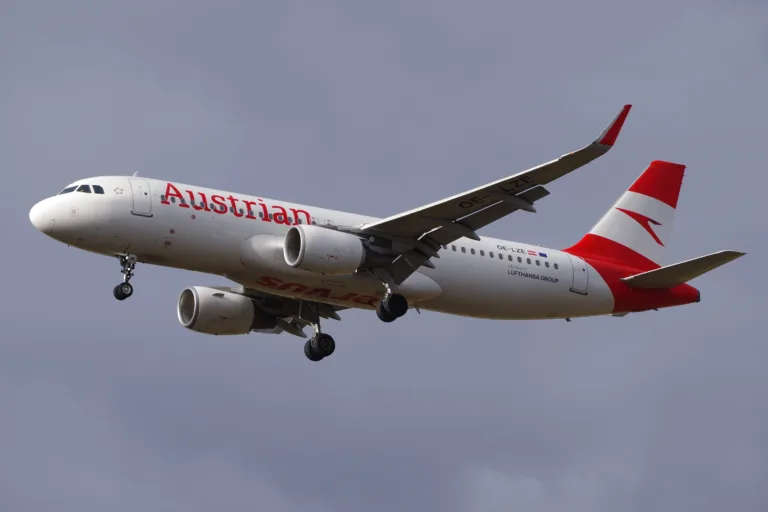
Austrian Airlines A320 diverted to Sofia following a bomb threat
Austrian Airlines flight OS82, travelling from Tel Aviv to Vienna on Sunday, October 18, diverted to Bulgaria’s capital after a threat was reported in flight. Associated Press and Reuters, citing Bulgarian transport officials, reported 51 passengers and six crew aboard the Airbus A320. Bulgarian military aircraft accompanied the approach, and the airliner was subjected to security checks on the ground. A precautionary diversion is not evidence that explosives were actually present. Published landing times differ between accounts, while the final outcome of the investigation was not established in the sources reviewed. AeroSillage’s dedicated coverage of OS82 sets out the sequence. The immediate passenger consequence was the interrupted journey to Vienna and the need for onward travel arrangements. No confirmed injuries were identified in the reporting examined for this review.
Riyadh reopens, yet airlines are not returning on the same timetable
Riyadh’s King Khalid International Airport reopened on Sunday, October 18, after security-related closure following attacks on the Saudi capital. But reopening an airport is different from restoring its international network. The National documented the airport’s reopening alongside widely varying airline suspension dates. On the same day, Indian carrier Akasa Air extended cancellations on both Riyadh and Jeddah services through October 27 inclusive, according to its October 18 travel update reported by NDTV Profit. Affected customers may obtain a full refund or reschedule without additional charges; the airline says refunds will return to the original payment method within seven days. The end date is not a promise that flights will restart the following morning. Travellers need confirmation for each sector and connection, rather than relying on the airport’s general operating status.
Italy’s air traffic capacity is back at 100% after network failure
Italy’s nationwide air traffic restrictions from October 16 have been lifted. ENAV, the country’s air navigation service provider, confirmed that its primary data network was restored and that operational capacity had returned to 100% later that day. The earlier sequence was more complicated than a complete shutdown: as morning demand rose, the network fault forced capacity down to 50%; an alternative satellite system then allowed it to climb to 75% before full restoration. ENAV said the problem involved data transmission, not a failure of air traffic control equipment itself, and ruled out malicious activity. A capacity figure describes how many flights the network can handle safely, not the percentage of flights that have actually arrived on time. That distinction prevents an outdated disruption alert from being carried into Monday as though the national restriction were still active. Airlines can nevertheless experience knock-on delays while aircraft and crews return to their planned rotations. The incident underlines why backup networks matter even when they cannot sustain the normal traffic volume.
France’s October 17–21 crew strike notice was suspended, not activated
Passengers flying through France during the school holiday period should distinguish the original strike notice from its subsequent suspension. Five unions representing pilots and cabin crew had called for a national stoppage from October 17 to 21 over changes to the rules governing work alongside retirement benefits. But SNPNC-FO announced on October 9 that the notice had been suspended after talks with the government over the CRPN supplementary pension scheme. A further decree remains awaited, so the unions have not declared the dispute permanently settled. Our English-language report on the French strike explains the policy issue and the change in status. There is no basis for describing the original nationwide October 17–21 walkout as currently under way. Nor does its suspension guarantee that every individual flight will operate: weather, staffing issues at particular operators and other operational factors still need to be checked separately. Compensation and assistance depend on the actual reason for any cancellation.
Frankfurt plans electric ground power at all 252 aircraft stands by 2030
An airport’s environmental footprint includes what happens while aircraft are parked, not only take-offs and landings. Fraport said on October 16 that around €8.7 million in German federal funding would support electric ground power and pre-conditioned air systems at Frankfurt Airport. By 2030, the operator aims to equip all 252 aircraft parking positions with either a fixed electrical connection or mobile battery-electric ground power units. Pre-conditioned air equipment, often shortened to PCA, supplies heated or cooled air to an aircraft cabin from the ground. Together these systems can reduce the need to run an aircraft’s fuel-burning auxiliary power unit during a turnaround. Fraport has not supplied a precise emissions saving for the new investment in this announcement, and ground electrification should not be confused with eliminating emissions from flying. For airlines, the operational questions include equipment availability at each stand, turnaround coordination and the reliability of power supply. The initiative is one part of the airport operator’s broader decarbonisation programme.


JOIN THE CONVERSATION
Let’s discuss this story.
A question, a clarification or a different perspective? Share it with us.