
The aviation journal
Press review
Essential aviation news, in perspective

Sunday’s aviation briefing moves from immediate risk to the systems that keep flying possible. The deadly attack at Riyadh airport raises urgent questions about operational information, while FAA traffic-management measures at San
Sunday’s aviation briefing moves from immediate risk to the systems that keep flying possible. The deadly attack at Riyadh airport raises urgent questions about operational information, while FAA traffic-management measures at San Francisco show how disruption propagates through networks. European regulators have updated technical guidance, and the airline industry is debating safety culture and carbon rules. For travellers, the key is to separate confirmed operational decisions from forecasts and commentary.
Riyadh airport attack: the immediate facts and the unanswered travel questions
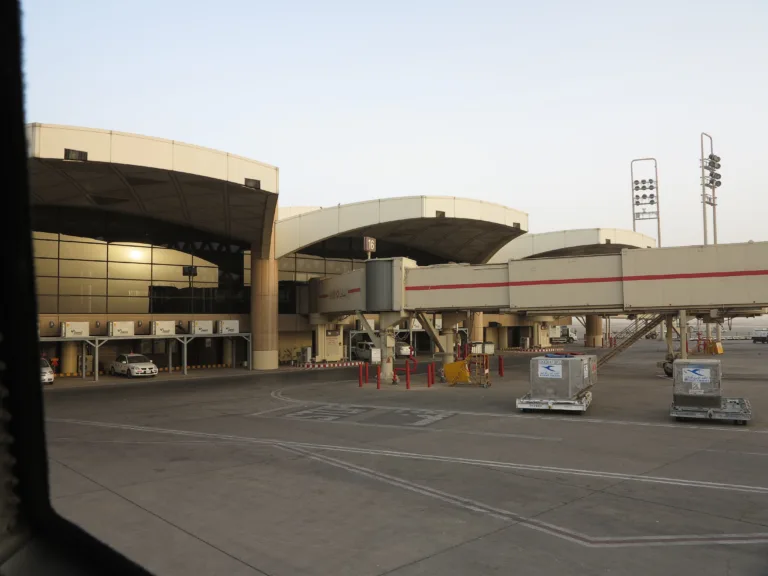
A strike on King Khalid International Airport on Saturday, October 10, killed 12 people and injured more than 300, according to Saudi authorities cited by the Associated Press. Airport operations were suspended and flights diverted. The incident is a material escalation from the regional airspace warnings and carrier suspensions that had already affected travel earlier in the week.
The figures describe a reported casualty toll, not a verified count of cancelled flights or a timetable for full reopening. Passengers should obtain itinerary-specific instructions from their airline rather than assume that every service in Saudi Arabia is affected in the same way. EASA’s existing Saudi airspace conflict-zone bulletin, issued September 30, is important background on operational risk; it should not be mistaken for a fresh blanket closure announcement.
Sources : Document ou reportage vérifié · Contexte réglementaire
San Francisco delays: what the FAA’s operational plan actually says
The US Federal Aviation Administration’s October 9 operations plan listed an active ground delay programme at San Francisco International Airport. Low ceilings were among the terminal constraints identified for San Francisco and other West Coast airports. A ground delay programme meters inbound traffic by assigning departure times upstream, reducing airborne holding and pressure on arrival capacity.
This distinction matters to connecting passengers: a flight can leave late even when the weather at its departure airport is good. It also prevents a misleading narrative that every delay is caused by a single staffing or weather event. The FAA plan is a time-stamped operational snapshot, not a prediction for the entire weekend. Travellers should check the latest carrier notice before changing arrangements.
Sources : Document ou reportage vérifié
Europe’s equipment-list rules get an important technical refresh
EASA published Issue 4 of its Easy Access Rules for Master Minimum Equipment Lists on October 6. The consolidated CS-MMEL material includes updates connected with FAA policy letters and is now accessible as a navigable online publication, PDF and machine-readable XML. The announcement is technical, but it addresses a central question in airline operations: under which tightly defined conditions may an aircraft dispatch with certain equipment unavailable?
A master list is not permission to disregard defects. Operators must work within approved aircraft-specific procedures, operational limitations and maintenance requirements. The revision can help technical teams find and interpret current material more consistently. For passengers, it offers a useful reminder that a short maintenance delay and a legal dispatch decision involve structured engineering judgement, not arbitrary discretion.
Sources : Document ou reportage vérifié
Aviation safety: IATA argues that AI cannot replace judgement
At its World Safety and Operations Conference in Istanbul, IATA argued on October 6 that future safety gains require people, technology and global standards to reinforce each other. Its priorities include transferring operational knowledge to younger professionals, preserving a culture where hazards are reported without fear and evaluating digital tools for resilience when systems fail or provide misleading data.
The message is particularly relevant to navigation interference and the wider use of artificial intelligence. Automation can improve awareness, but crews and controllers still need training, independent checks and credible fallback procedures. IATA’s remarks are an industry position, not a new regulation. Their value lies in identifying practical areas where regulators and operators can measure whether technology improves decisions in the real world.
Sources : Document ou reportage vérifié
Ten years after CORSIA: the airline carbon debate is not settled
The airline trade body IATA marked the tenth anniversary of the 2016 ICAO CORSIA agreement by urging governments to strengthen the global aviation-emissions framework. It highlighted pressure on the supply of eligible carbon credits and concerns that overlapping national schemes could add complexity and cost to international operations.
CORSIA is a market-based offsetting mechanism, not a substitute for reducing fuel burn, improving aircraft efficiency or increasing sustainable aviation fuel use. The difference matters when evaluating airline climate claims. Nor does the industry statement establish a single inevitable ticket-price effect: compliance costs and commercial responses vary. The coming policy debate will test how governments balance environmental integrity with a coherent international system.
Sources : Document ou reportage vérifié
Brussels on Monday: watch the rail and bus journey, not just the flight
Brussels Airport says the public-sector union action scheduled for Monday, October 12 is not expected, on current information, to affect flights. Public transport to and from the airport could nevertheless be disrupted. This follows the separate October 9 action affecting parts of the Alyzia ground-handling operation; the two events should not be presented as the same strike.
For a passenger, a flight showing ‘on time’ is only part of the journey. Rail, bus and local transport updates may determine whether the check-in deadline can be met. The airport directs travellers to the relevant Belgian transport operators. As with any forecast, the ‘no flight impact expected’ assessment should be checked again before departure.
Sources : Document ou reportage vérifié

JOIN THE CONVERSATION
Let’s discuss this story.
A question, a clarification or a different perspective? Share it with us.