Aviation news on 24 September is being shaped by three broad trends: airlines are still investing heavily in their fleets, labour disputes remain capable of disrupting networks at very short notice, and navigation systems are emerging as a new operational point of attention. For European and French-speaking travellers, the swift end of the Icelandair strike brings some relief, while reported GPS issues affecting Embraer E2 aircraft deserve close monitoring. At the same time, Turkish Airlines has confirmed a major 737 MAX order and sanctions targeting Iranian aviation continue to have regional consequences.
Turkish Airlines confirms 100 Boeing 737 MAX jets and keeps 50 options
Turkish Airlines has finalised a firm order for 100 Boeing 737 MAX aircraft, with options for 50 more. The agreement strengthens the renewal of the Turkish carrier’s narrow-body fleet and complements its previous long-haul commitments. Discussions over engine maintenance costs had complicated the deal, but the announcement now closes an important chapter for Boeing.
Why it matters. Istanbul is one of the main connecting hubs used by travellers from France and across Europe, particularly for journeys to Asia, the Middle East and Africa. A larger and newer fleet gives Turkish Airlines more capacity to expand its European network and feed its hub. For Boeing, the deal is also strategic: it reinforces the 737 MAX backlog against Airbus’s A320neo family at a time when delivery slots remain highly contested. AeroSillage has a separate report on the Turkish Airlines order and what it means.
Sources: FlightGlobal, 24 September 2026; Boeing and Turkish Airlines industry information.
Embraer investigates GPS “instability” affecting some E2 aircraft
Embraer and Honeywell are investigating the cause of GPS reception problems reported on some E190-E2 and E195-E2 aircraft. The issue has disrupted Azul operations in Brazil, while reports have also involved several international operators. Embraer says the aircraft have alternative navigation systems and that, under the conditions known so far, the problem does not affect flight safety. The precise cause has nevertheless not yet been established.
Why it matters. Safety and operational availability must be distinguished. An anomaly that prevents an aircraft from meeting navigation requirements before departure can cause a delay or cancellation even when backup solutions are available in flight. The E2 is operated in Europe, including by KLM Cityhopper and Helvetic, so any corrective action from Honeywell or Embraer could have implications well beyond Brazil. The issue also highlights modern aviation’s growing dependence on satellite signals, already challenged by jamming and spoofing in several regions.
Sources: FlightGlobal, 24 September 2026; Embraer and Honeywell statements issued on 22 and 23 September.
Icelandair: mechanics’ strike ends after a day of disruption
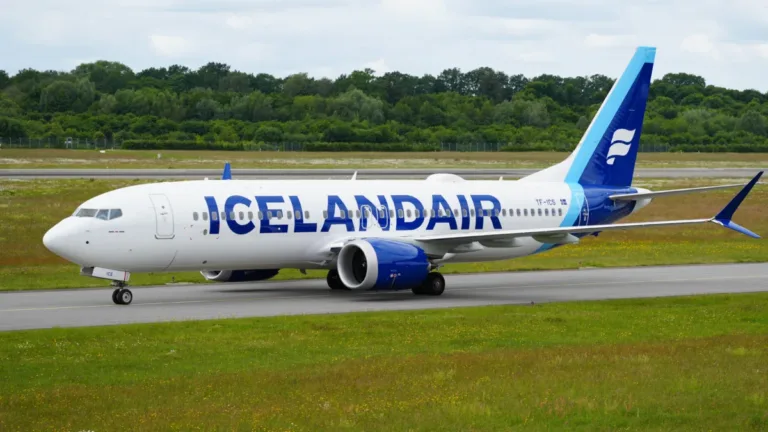
The indefinite strike by Icelandair mechanics, which began overnight from 22 to 23 September, has been halted after cancellations and disruption affecting thousands of passengers. Mechanics have returned to work and the airline is restoring its schedule. This is a substantial change from yesterday’s situation: the risk of a prolonged paralysis of the Icelandic network has receded.
Why it matters. Keflavík plays a distinctive role between Europe and North America, and Icelandair sells a large number of transatlantic connections. Even a short interruption can disrupt several rotations and require time to reposition aircraft and crews. For passengers booked to travel over the next few days, a return to work therefore does not necessarily mean an immediate return to normal operations. AeroSillage is following Icelandair’s return to normal operations.
Sources: FlightGlobal, 24 September 2026; RÚV and Icelandic media, 23 September.
Qantas: 24-hour strike at four major Australian airports
Qantas airport employees launched a 24-hour strike on Thursday at Sydney, Brisbane, Adelaide and Perth as part of a pay dispute. The action affects several of the country’s main gateways and comes as the airline manages a dense domestic and international schedule.
Why it matters. Australia is geographically dependent on air transport and Sydney is a major entry point for European travellers. The direct impact on France remains limited, but connections via Asia and the Middle East can suffer knock-on effects when domestic flights no longer feed long-haul services efficiently. The episode above all illustrates how vulnerable major networks can be to labour disputes affecting ground operations, even when flight crews themselves are not on strike.
Source: Reuters, 24 September 2026.
Iran: US sanctions trigger cancellations and renew regional tensions
Iranian airlines have cancelled several international flights after a further tightening of US sanctions targeting the aviation sector. Tehran has also warned neighbouring countries against potential restrictions on Iranian carriers. Some flights to China and Russia are continuing, but the situation remains fluid and the precise consequences depend on decisions taken by states and service providers.
Why it matters. The issue goes beyond Iranian airlines alone. Restrictions can affect overflight permissions, ground handling, payments, spare-parts supply and route planning. For European airlines, any new rise in tensions in the Middle East can also mean diversions, higher fuel burn and schedule changes. The established facts are the cancellations and tighter sanctions; the lasting scale of regional disruption remains uncertain.
Sources: Reuters, 23 September 2026; regional media and information from the airlines concerned.
Heart Aerospace revises its electric-aircraft project again with the ES-36
Heart Aerospace has unveiled the ES-36, the latest evolution of its electrified regional-aircraft programme. The manufacturer is abandoning an independent hybrid-electric architecture in favour of a simplified two-electric-motor configuration, while JSX has announced a commitment for 100 aircraft. This is the fourth major evolution of the concept since the programme was launched.
Why it matters. The regional market is still looking for a credible way to cut emissions sharply on short routes, but battery energy density and certification requirements impose severe compromises. Heart’s repeated changes show how difficult it remains to move from demonstrator to commercial product. The programme should therefore be read as an indicator of the maturity of electric aviation, not as proof that a transformation of regional air transport is imminent.
Sources: FlightGlobal and AeroTime, 24 September 2026; Heart Aerospace.
The thread running through today’s news
This edition shows an aviation sector pulled by two opposing forces. On one side, Turkish Airlines’ order and Heart Aerospace’s new project reflect continued confidence in traffic growth and technological renewal. On the other, the Icelandic strike, the Qantas industrial action, Iranian sanctions and the E2 GPS anomaly are reminders that network performance depends as much on operational resilience as on the number of aircraft ordered. For passengers, the consequence is very concrete: behind fleet announcements, it is the availability of aircraft, staff, infrastructure and air routes that ultimately determines the reliability of a journey.