Aviation news on 23 September is dominated by operational disruption. In Iceland, the Icelandair mechanics’ strike is now under way and is affecting several thousand passengers. At Charleroi, the air traffic controllers’ dispute continues, with dozens of cancellations. At the same time, US restrictions targeting Iranian airlines are entering a decisive phase. These tensions are compounded by the continuing fragility of US air traffic control infrastructure, heightened scrutiny of SpiceJet in India and Riyadh Air’s continuing expansion in Europe.
Icelandair: the strike begins and hits the network
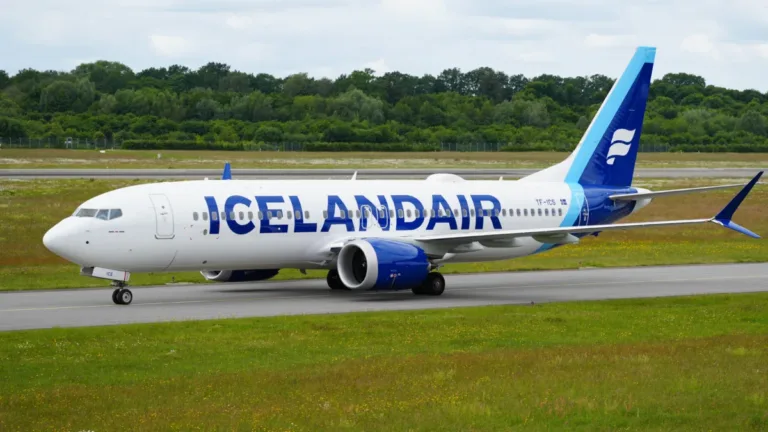
The indefinite strike by Icelandair mechanics began at 00:01 on Wednesday. The airline cancelled its morning departures from Iceland, representing 26 international rotations and five domestic rotations and affecting nearly 5,500 passengers. The action has no end date and further cancellations are expected if no pay agreement is reached. AeroSillage is following the Icelandair dispute and its consequences for travellers.
Why it matters. Keflavík is not only Iceland’s main gateway: it is also a connecting hub between Europe and North America. A prolonged shutdown can therefore affect travellers using Reykjavík as a transit point. The open-ended nature of the notice distinguishes this crisis from a one-off disruption: the airline has to rebuild its schedule day by day and rebook thousands of passengers in a market where alternative capacity is limited.
Sources: Icelandair/Icelandic Aircraft Mechanics Association, Iceland Monitor, Iceland Review, operational information published on 23 September.
Charleroi: 42 flights cancelled on Wednesday
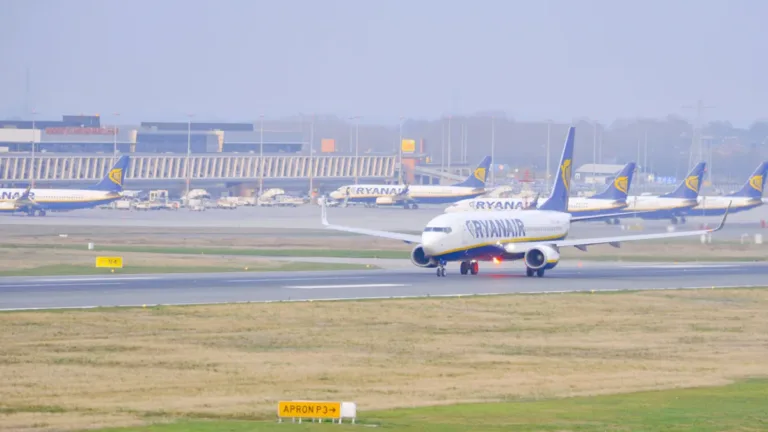
Brussels South Charleroi expected 42 cancellations on Wednesday, including 12 in the morning and 30 in the evening, while 14 other flights were due to be rescheduled. Skeyes air traffic controllers have been striking overnight from 22:00 to 08:00 since 16 September, with action announced until 10 October. More than 200 flights have already been cancelled. AeroSillage is tracking the disruption at Charleroi.
Why it matters. The Belgian airport is an important low-cost gateway for northern France, Belgium and Luxembourg. Ryanair accounts for most of its activity and several routes to Marseille, Figari and Mediterranean destinations are exposed. The new factor is no longer the existence of the dispute but its duration: the accumulation of cancellations is turning a local disagreement over night-work allowances into a schedule-reliability problem lasting several weeks.
Sources: Brussels South Charleroi Airport, Skeyes, Aviation24.be, 22 September.
Iran: air transport faces a growing risk of isolation
New US threats of secondary sanctions against service providers supplying fuel, ground handling or commercial services to Iranian airlines take effect on 23 September. Routes to several countries have already been cancelled or reduced, while some services are still operating. This is therefore not a universal legal closure of airspace to Iranian carriers, but an economic pressure campaign that could make their international stops materially impossible.
Why it matters. For European travellers, the impact is mainly indirect: fewer connection options, greater uncertainty around tickets and a shift of traffic towards neighbouring hubs. The situation must be monitored carefully because implementation depends on states, airports and service providers. The distinction between the threat of sanctions and the effective suspension of flights remains essential.
Sources: U.S. Treasury, Wall Street Journal, Al Jazeera, Reuters, 22–23 September.
United States: flights resume, but the FAA outage leaves a mark
Operations resumed at major airports in the north-eastern United States after the communications failure that had heavily disrupted Newark, Philadelphia, JFK and LaGuardia. Authorities said a primary line failed and a backup fibre was cut during construction work. Hundreds of flights were cancelled and disruption continued into Tuesday.
Why it matters. For passengers departing Paris and other major European hubs, New York is one of the most important transatlantic markets. More broadly, the incident highlights a lack of redundancy in critical infrastructure: losing the main circuit and then the backup was enough to disrupt several airports. It also comes as a GAO report points to vulnerabilities in US aviation communications to jamming and spoofing. The issue therefore goes beyond delays and raises a broader question about system resilience.
Sources: FAA, Associated Press, GAO, Reuters, 21–22 September.
SpiceJet placed under enhanced supervision in India
India’s regulator has placed SpiceJet under strengthened operational and financial surveillance amid persistent cash-flow difficulties worsened by tensions in the Middle East. The enhanced oversight is intended to monitor more closely the airline’s ability to maintain operations and meet its obligations.
Why it matters. SpiceJet is not a major player in the French market, but the case highlights an important principle: an airline’s financial health can become a safety and continuity issue when it affects maintenance, suppliers or fleet availability. India is also one of the fastest-growing aviation markets in the world; the difficulties of an established carrier show that strong market growth does not protect every operator.
Sources: Indian Ministry of Civil Aviation, DGCA, Reuters, 22 September.
Riyadh Air adds Milan to its European expansion
Riyadh Air has opened bookings for its future Riyadh–Milan Malpensa service, scheduled to start on 16 December with four weekly Boeing 787-9 flights. Milan becomes its fifth European destination and the fifteenth destination on sale. The Saudi airline is therefore continuing a rapid build-up after several openings in Asia and Europe.
Why it matters. For the French market, Milan is not an isolated route: it confirms Riyadh Air’s strategy of rapidly building a European network capable of feeding its Saudi hub. Competition with Emirates, Qatar Airways, Turkish Airlines and European groups is gradually concentrating on the same Europe–Asia flows. More European gateways could also put pressure on fares and intensify competition for connecting traffic to Asia.
Sources: Riyadh Air, Saudi Press Agency, Aviation Week, 22 September.
The thread running through today’s news
This edition shows two opposing movements. On one side, air networks remain vulnerable to labour disputes, technical infrastructure and geopolitical tensions: Icelandair, Charleroi, the FAA and Iranian airlines provide four very different examples. On the other, carriers continue to invest and open new markets, as Riyadh Air is doing in Europe. For travellers, the immediate lesson is simple: global air capacity continues to grow, but journey reliability increasingly depends on factors that sit far beyond the airline name printed on the ticket.